
 Prompted by acquiring this lovely and interesting Sidney Hall map of London from Tim Bryars – you can (or will shortly) be able read about the map itself on his own blog (Unto the Ends of the Earth – very highly recommended – link in the blog-roll to the right) – but it set me reminiscing about being asked, many years ago, to research Sidney Hall for the Oxford Dictionary of National Biography – and the curious story that slowly emerged.
So this is not new research (except in that I can now tell you one fresh fact, courtesy of notes from David Alexander, who has found something I couldn’t find, although I looked hard enough, in the records of the Worshipful Company of Cooks of London) that Hall was an apprentice of the map-engraver George Neele).
We all thought we knew roughly about Sidney Hall of Bury Street, Bloomsbury – a prolific and innovative mapmaker and engraver active in London from about 1810 until at least the 1850s. Lots of his maps in all the major collections. I began my search by trying to trace a record of his death and from there perhaps a will. Births, marriages and deaths have been centrally registered in England and Wales since the middle of 1837 – all indexed and on the internet now, a matter of seconds to look things up (it’s not all bad this interweb thingy) – but back then it was a matter of visiting the archives and ploughing through the back-breaking volumes of quarterly returns. Page after page of Halls, hour after hour of eye-strain and total concentration – but not a remotely plausible Sidney anywhere near the probable date. And what a business it was in those days to try and find a census return. He wasn’t there either. A man patently still alive after 1850 – the record of his work told us so – his name appears in London street directories up until at least 1851 – but no trace at all that I could find.
After second and third fruitless visits to archives, I bemoaned the complete impossibility of all this to my then assistant – a young woman of Italian extraction, possessed of a mordant wit and a perhaps florid view of domestic relationships. “Look for his wife”, she said, “she probably did away with him for the money and buried him under the floorboards” – “Don’t be ridiculous, Enza”, I replied, “This is England – this was Bloomsbury not Bologna – these things don’t happen here”: “I’m telling you, look for the wife, cherchez la femme – that’s always where the answer lies”, she replied darkly and enigmatically.
 And, bizarrely, in a way, she turned out to be right. I was looking through the British Library copy of John Gorton’s serially published Topographical Dictionary (1831-1832), the attractive county maps by Hall dated month by month, as they appeared, in roughly alphabetical order, when I noticed something slightly odd. All the earlier maps, down to Oxfordshire, to be precise, are signed with Hall’s characteristic “Engraved by Sidy. Hall” – but from Rutland onwards, published September 1st 1831, the maps were now signed with the simpler form “Engraved by S. Hall”.
  Did this mean anything more than that the engraver was sparing the effort of those extra three letters? I looked again – was it my imagination, but weren’t these later “S. Hall” maps just a little bit looser in the engraving? Had something happened to Sidney Hall?
A hunch inspired wholly by Enza’s malign prognostications sent me hurrying off to another archive to scour the burial records of the parish of St. George Bloomsbury. And there the answer was. Not under the floorboards certainly, but buried him she had – and said very little about it. On 27th February 1831 – at least twenty years earlier than anyone had ever suspected – was buried Sidney Hall of Bury Street, at the age of just forty-two. And slowly it all fell into place. Hall had married one Selina Price ten years earlier at the same church and his will, now findable and found, expressly contemplated the possibility of his widow, Selina Hall, continuing “to carry on my said business of an engraver and printer”. She was evidently competent to do so and evidently she did, silently, seamlessly and without fuss, year by year, successfully letting the world go on believing, unless it enquired very much more closely, that “S. Hall” stood for Sidney and not Selina.
The rather complex will, heavily interlined and partly illegible (at least in the digitised image I have to hand) left alternative provisions depending on whether Selina continued the business or not. We have no reason at all outside Enza’s flight of fancy to suppose that there was anything suspicious about Sidney’s death – but there just may have been a motive. And so, silently and secretly, Selina carried on the business for the next twenty-two years, admitting only to census officials that she was herself both engraver and copperplate printer, until her own death in 1853, when the business passed to her nephew, Edward Weller – another prolific mapmaker – provision for whose apprenticeship and training had also been made in Sidney’s will.
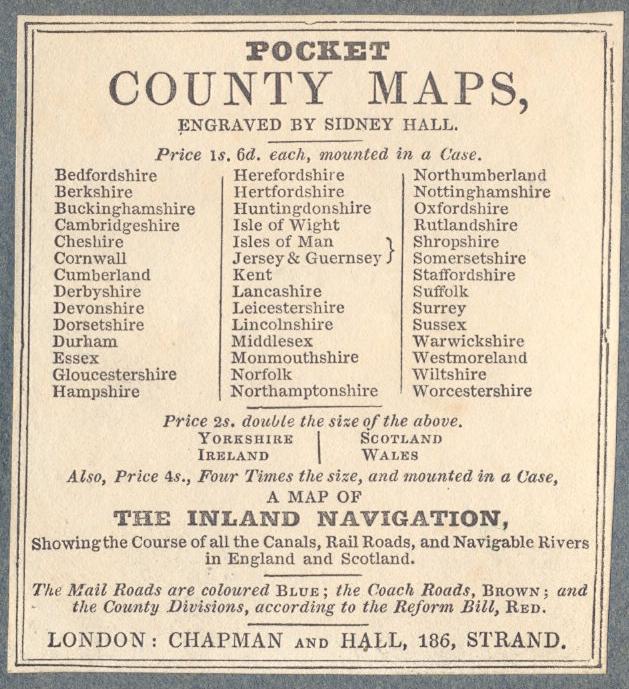
 The county maps for Gorton’s dictionary were also published separately by Chapman & Hall with the original publication dates delicately sanded off. Here is Selina’s map of Surrey – one of her very earliest – November 1831. But the maps, of course, still all advertised as being by Sidney – and so it continued.
 One would like to know more about her. The 1851 Census is the source for saying that both she and her younger sister, Margaret Weller, were born in Radnorshire in mid-Wales. Her age was given then as seventy-four, but as only seventy-one when she died two years later – so we can only guess that she was born somewhere around 1780. No record has been traced. She had evidently been involved in some way with the business for a good many years. Sidney Hall’s former business partner, Michael Thomson, also died young, at the age of about thirty: his will, proved early in 1816, mentions debts to her which must be repaid before anything else is settled (don’t tell Enza) and leaves her a bequest of five guineas. Sidney Hall took over the Bury Street premises, leased from the Duke of Ancaster, and married Selina Price five years later. And that is as far, currently, as the biographical record runs.
One of the couple’s near neighbours in Bury Street was George Shillibeer, inventor of the London omnibus. I covet the illusion that Shillibeer may have looked at a copy of this London map one day and – right there and right then – dreamed of a network of bus-routes all across it – but that’s just another flight of fancy.
As I say, this is not a fresh piece of research – much of it long since published – so I was a little surprised this morning to search COPAC (the online catalogue of all the major UK libraries) and not to find a single map ascribed to Selina Hall. Of the 700 or so maps and atlases listed under Sidney Hall, certainly a third, perhaps even a half, are those of a dead man – they must surely be by her. Time, is it not, map cataloguers and map librarians, to give the lady her due? It’s all in ODNB and there’s more in “British Map Engravers”. Hello, National Library of Wales? Llyfrgell Genedlaethol Cymru? – that 1832 map of Wales? – it’s by Selina (woman from Wales!) – not Sidney.


 The Bookhunter on Safari